

Why ChatGPT Recommends Your Competitors Instead of Your Store
Does your SEO rankings matter to ChatGPT? Learn why AI recommends competitors with worse traffic but cleaner data, and master the 5 trust signals that actually drive AI citations.
You rank #1 on Google. Solid traffic. Good conversion. Then you test what ChatGPT says about your products.
Three competitors get recommended. Your store doesn't appear.
Surfer SEO analyzed 25,000 AI Overview citations and found that 67.82% don't rank in Google's traditional top 10. Pages ranking #1 get used only 17% of the time.
Hidden Visibility
Source: Surfer SEO
Google rankings don't translate to AI visibility. The systems work differently.
I've audited over fifty stores in six months. The pattern is consistent: stores with strong SEO get ghosted by AI, while competitors with weaker rankings but cleaner data get cited repeatedly.
Visitors from AI search convert 4.4x higher than traditional organic traffic. These are people ready to purchase. If AI recommends competitors during high-intent searches, you're losing your most valuable traffic.
Conversion Impact
Source: PPC Land
Rich Clark's research shows AI Overviews appearing for 18.5% of commercial queries currently. Retail sits at less than 3%. That gap is closing. The stores AI learns to trust now will be harder to displace later.
How AI Actually Decides What to Recommend
Most store owners think AI works like Google. Optimize content, AI finds your pages, you get recommended.
Wrong.
When someone asks ChatGPT about products, it doesn't already "know" the answer. It searches for information in real-time and writes a response based on what it finds.
Think of it like an open-book exam. Someone asks about brake pads for a Mustang. ChatGPT looks at your website, Google Merchant Center feed, Reddit threads, review sites, competitor pages, forums. Then it writes an answer based on which sources seem most reliable.
AI Competence's analysis shows these systems score each source on trustworthiness. Your Google ranking means AI can find you. Being findable and being trustworthy are different.
Here's what happens: Your product page shows $89.99. Your Merchant Center feed from two weeks ago lists $79.99. Your Amazon listing shows $94.99. A Reddit thread mentions $85.
Four different prices for the same product. AI doesn't know which is correct. So it avoids you, gives vague answers, or picks the competitor whose price is identical everywhere.
When your data conflicts, AI treats you as unreliable.
The 5 Signals That Determine AI Citations
Signal 1: Data Consistency
Does your information match across your website, Merchant Center, Amazon, marketplaces?
According to Inflow Inventory, many Shopify stores sync feeds manually or daily. Product pages update instantly, but feeds lag 24 hours. That creates contradictions AI notices.
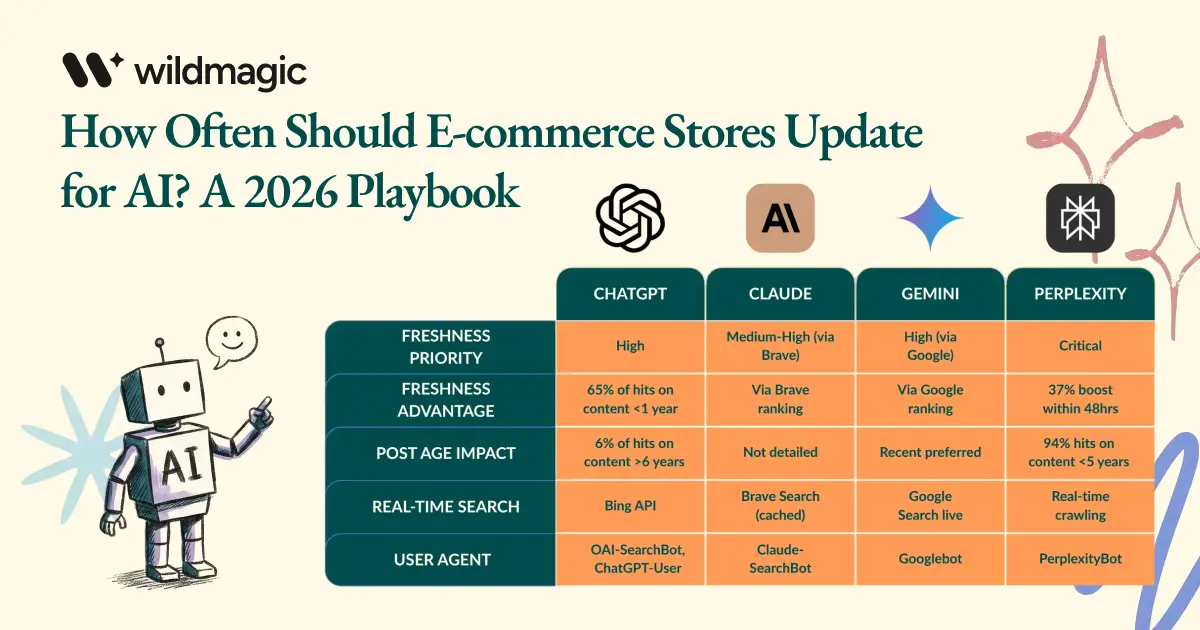
Check your Merchant Center sync timing. If you launched a sale yesterday and your feed shows old prices, AI sees conflicting data. For comprehensive strategies on maintaining fresh data that AI systems trust, see our AI Freshness Playbook for E-commerce 2026.
Signal 2: Product Clarity
Can AI read your product information without guessing?
Many stores put details in images or design elements that look good but are invisible to AI. Your hero banner shows "Premium 500W Solar Panel" in beautiful typography. AI sees a blank image.
Competitors using proper HTML structure make data explicit: "Power: 500W" in a specs table, "Price: $89.99" marked as the price, "Warranty: 25 Years" in a structured list. AI doesn't have to guess what "500W" refers to. The structure explains it.
Signal 3: Reviews & Sentiment
Where people talk about your products matters more than review count.
AI doesn't fully trust reviews on your website. You control those.
Five hundred reviews on your store count less than fifty mentions scattered across Reddit, YouTube, forums, and independent review sites.
Evident AI's guide confirms AI systems weight independent sources higher. They're perceived as unbiased. Your descriptions are assumed marketing.
You need external social proof. Some Reddit discussions recommending your products. YouTube reviews. Forum threads where your brand comes up naturally. That diversity signals real customers.
Signal 4: Crawlability
Can AI bots actually access your product pages?
Many stores accidentally block AI. Sobefy's guide found Shopify's default settings can prevent ChatGPT and Perplexity from reading your store.
Check yourstore.com/robots.txt. If you see User-agent: GPTBot followed by Disallow: /, you're blocking ChatGPT.
Another problem: content that only loads with JavaScript. Prices and specs that don't exist in raw HTML.
Test it: in Chrome, open Developer Tools (F12), disable JavaScript in Settings, reload your product page. What disappears? If prices or specs vanish, AI likely can't see them.
Signal 5: Entity Confidence
Does Google recognize your business as real and established?
When you search major brands on Google, you see a knowledge panel on the right: founding year, location, key people, official website. That's Google's Knowledge Graph showing verified businesses.
Global Lingo explains how Google verifies businesses across authoritative sources. When you have this verification, AI sees you as legitimate and established.
Competitors in Google's Knowledge Graph have automatic trust advantage. New stores without verification get treated as higher risk. Build this by: setting up Google Business Profile, getting listed in industry directories, keeping your business name, address, phone identical everywhere, and earning mentions in news or industry publications.

Shopify-Specific Problems
Trapped Text: Shopify themes love hero banners with text overlays. Looks great to humans. Invisible to AI. When text is part of an image file, bots can't read it.
Connor Gillivan's analysis shows most themes prioritize visual design over data structure.
The fix: add the same text as actual HTML text somewhere on the page. Put it in a paragraph further down the page where users won't see it as duplicate content, or include it in your meta description. Just make sure it exists as readable text in your page code, not only as pixels in an image file.
Vague Titles: Creative product names hurt visibility. "The Speedster 500" doesn't tell AI it's brake pads.
Structure titles as: [What It Is] → [Key Features] → [Brand Name]
Example:
Track Day Brake Pads for Ford Mustang
→Carbon Ceramic
→Speedster 500
Schema Neglect: Shopify includes basic structured data automatically, but it's missing details AI systems look for. Things like GTIN (the barcode number on your product), MPN (the manufacturer's part number), exact material composition, and detailed compatibility information.
These details help AI understand precisely what you're selling and whether it matches what someone asked for. This YouTube guide covers how to add these enhancements.
Most Shopify stores never go beyond the default. Adding comprehensive product details gives you an edge.
The Automotive Parts Case
I worked with an auto parts store last quarter. Mid-six figures revenue. Strong Google rankings. ChatGPT never recommended them for "What brake pads fit a 2018 Silverado?"
They sold brake pads that fit multiple truck models and years. One product, many compatible vehicles. But they never explicitly listed which ones.
Compatibility information existed in PDF spec sheets, buried in reviews, scattered in forum posts. None of it structured for AI to read.
The competitor laid it out in a simple HTML table: Make, Model, Years. Chevrolet Silverado 1500, 2014-2024. GMC Sierra 1500, 2014-2024. Clear. Unambiguous. Safe for AI to cite.
We rebuilt their compatibility information using structured tables. Within three weeks, ChatGPT citations improved measurably.
The lesson: scattered information creates confusion. Organized, explicit information creates confidence.
- Prompt Test: Ask ChatGPT: "What are the best [your product category] for [specific use case]?" Write down which brands get recommended. Not mentioned? That's your first red flag. Test Perplexity and Google AI Mode too since different AI systems use different data.
- Consistency Check: Compare your Shopify page, Google Merchant Center feed (export as CSV), Amazon listing, marketplace listings, and blog content. Write down price, availability, and specs from each. They should be identical.
- Accessibility Check: Open your product page in Chrome. Press F12, go to Settings > Debugger, check "Disable JavaScript," reload. What disappears? If prices or specs vanish, AI can't see them. Also check yourstore.com/robots.txt for lines blocking "GPTBot" or "PerplexityBot."
- Social Proof Check: Search Google for
site:reddit.com "your brand name". Recent results mean external discussions exist. Old or no results mean AI sees you as low confidence.
These are only the top of the iceberg and most common problems. Check our complete guide for detailed analysis including RAG mechanics, universal audit frameworks, and platform-specific optimization strategies.
Taking Control
Only 3% of retail queries have AI Overviews currently. That percentage will increase. Fast.
The stores that build trust with AI systems now will be harder to displace later. AI learns which sources are reliable and consistent. Once it tags you as trustworthy, that compounds. Your clean data becomes a competitive advantage.
This isn't about more content. Most stores have a data quality problem, not a volume problem.
Search Engine Journal found 43% of AI citations point to Google's own properties, primarily Merchant Center data.
Google Preference
Source: Search Engine Journal
Focus there. Your Merchant Center presence, structured data, consistency across platforms. These are the foundation.
AI visibility isn't about gaming algorithms. It's about making it impossible for AI to misinterpret what you sell, what it costs, whether it's available.
Clean data. Consistent data. Structured data. That's the competitive advantage. Not who has the most content. Who has the clearest data.
Ready to stop being invisible?
We can fix why AI is skipping your store. It might be your schema. It might be your feed. It might be contradictory data you didn't even know existed.
Book a 30-minute audit. I'll show you exactly what ChatGPT, Perplexity, and Gemini see when they look at your store. No pitch. Just data.
— Emre