
How Often Should E-commerce Stores Update for AI? A 2026 Playbook
Perplexity wants 48-hour freshness. ChatGPT cares about months. Claude pulls from Brave. A practical playbook for e-commerce stores to get cited by each major AI system in 2026.
Roughly 60-70% of all AI bot visits go to content updated within the past year.
That number shifts by industry. Financial services? Bots want it fresh. Industrial sectors? They'll crawl 10-year-old content without blinking. The key is figuring out where your business stands.
For e-commerce, you're closer to the financial services end. Way closer.
E-commerce is just too fast. Prices change. Campaigns rotate. Black Friday pricing from last year is useless this year. The industry is naturally hectic. AI bots know this. They tackle uncertainty by prioritizing fresh content.
But how fresh is "fresh"? What's the catch?
Each major AI crawler weights freshness differently. The deviation isn't huge tho. It ranges from "important" to "very important". The real question is: what counts as fresh for each one?
Here's what I found.
How Each Crawler Judges "Current"

Perplexity treats freshness as the ultimate enemy of hallucination. It's their number one quality signal. The time brackets work roughly like this: last hour, last 48 hours, last 2 weeks, then everything else. Content updated within 48 hours gets up to 37% more citations. That advantage flattens to 14% after two weeks.
Here's the interesting part. Even minor edits can reset the clock. A small update to a product description? Perplexity sees it as fresh again. If your store gets significant traffic from Perplexity, this is a huge lever.

ChatGPT is more relaxed about it. Not "doesn't care" relaxed. More like "you have breathing room" relaxed. 65% of their bot traffic goes to content under a year old. Under two years? 79%. Content older than six years gets basically ignored. Only 6%.
So you're not racing against hours here. You're racing against months. Monthly updates to your key products keep you visible. That's manageable.

Gemini is interesting. It doesn't have its own freshness logic. It just inherits whatever Google Search already does. If Google thinks your query deserves fresh results, Gemini pulls fresh results. Product searches, seasonal campaigns, trending stuff? Fresh matters. Evergreen guides? Less so.
The real benefit here: if you're already doing SEO right, you're halfway there. Gemini's grounding system pulls live search data to reduce hallucinations. Already indexed? Already eligible.

Claude is the weird one. It doesn't really crawl your site. It pulls from Brave Search. 86.7% overlap with Brave's top results. Freshness? Almost irrelevant. What matters is whether Brave ranks you. Totally different game. If Claude matters for your business, you're optimizing for Brave, not for Claude directly.
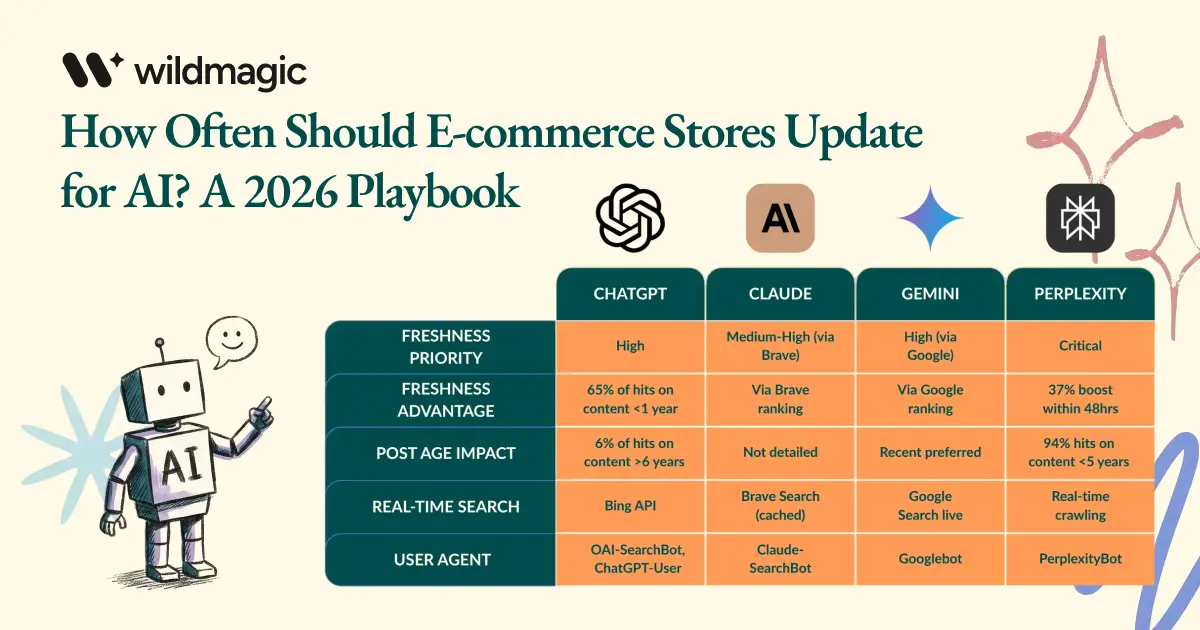
Comparison Table
| Aspect | ChatGPT | Claude | Gemini | Perplexity |
|---|---|---|---|---|
| Freshness Priority | High | Medium-High (via Brave) | High (via Google) | Critical |
| Freshness Advantage | 65% of hits on content <1 year | Via Brave ranking | Via Google ranking | 37% boost within 48hrs |
| Post Age Impact | 6% of hits on content >6 years | Not detailed | Recent preferred | 94% hits on content <5 years |
| Real-Time Search | Bing API | Brave Search (cached) | Google Search live | Real-time crawling |
| User Agent | OAI-SearchBot, ChatGPT-User | Claude-SearchBot | Googlebot | PerplexityBot |

Step-by-Step: What To Do
So what do you actually do with this?
First, figure out who's visiting. Check your server logs. Look for PerplexityBot, OAI-SearchBot (that's ChatGPT), Googlebot, ClaudeBot. Most e-commerce stores see ChatGPT and Gemini dominating. But not always. Tech products? Claude shows up more. Lifestyle and shopping queries? Perplexity punches above its weight.
Don't assume. Look at your actual traffic. The split matters because it tells you which clock you're racing against.
Second, pick your top 10. Your top 10 revenue products. These get monthly updates. No exceptions. Doesn't have to be a rewrite. New customer review snippet. Updated comparison. Refreshed specs if anything changed. Small touches count. Remember: minor edits reset the freshness clock for Perplexity.
Monthly sounds like a lot. It's not. Ten products. Once a month. That's two or three per week if you batch it.
Third, work backwards from your calendar. Black Friday? Update those pages 48 hours before. Not the day of. Not the week of. 48 hours. That's Perplexity's sweet spot. Holiday campaigns, seasonal launches, flash sales. Same logic. Get there early.
Most stores update campaign pages after they launch. By then you've already missed the citation window.
Fourth, don't ignore your category pages. Product pages get all the attention. But category pages are how AI understands what you actually sell. "Winter boots" as a category tells AI more than 50 individual boot listings. Update these bi-weekly. Add new arrivals. Refresh the copy. Keep them alive.
Fifth, check if Brave knows you exist. If Claude matters for your niche, search your products on Brave. Not Google. Brave. Are you showing up? If not, that's a different problem. Freshness won't help you if Brave doesn't have you indexed in the first place.
Here's the thing nobody talks about. This isn't a one-time fix.
AI models change. Crawl behaviors shift. What works in January might not work in June. Perplexity could tighten their freshness window tomorrow. ChatGPT could start caring about hours instead of months. Nobody sends you a memo when it happens.
The stores that win at this aren't the ones who optimized once. They're the ones who built freshness into how they operate. Monthly product reviews. Pre-campaign updates. Category pages that actually reflect current inventory.
It sounds like a lot. It's really not. It's just a different habit.
Most e-commerce stores already update their sites constantly. New products. Price changes. Campaign rotations. The work is already happening. The shift is making that work visible to AI at the right time.
Different clocks. Different rules. But once you know which clock you're on, the rest is just rhythm.
Need help finding your rhythm?
We audit e-commerce stores for AI visibility. In 30 minutes, you'll know exactly which crawlers are visiting, what they're seeing, and where your content update gaps are.
No pitch, just clarity.
— Emre