

Google Agentic Shopping: The Complete Guide to Direct Offers & UCP
We break down the mechanics of Google Direct Offers, the new Universal Commerce Protocol (UCP), and the 4-layer S.A.L.E strategy you need to get recommended by Gemini. This is your playbook for the shift from SEO to Agentic Optimization.
Section 1: The Shift is Already Happening
Yesterday, (January 11, 2026), Google walked into the National Retail Federation's Big Show and announced something most people missed the significance of.
Not a new ad format. Not another Shopping update. They announced the infrastructure for AI-native commerce. Which we call Embedded Commerce in Wildmagic.
Three things launched together
1. Direct Offers. Your store creates exclusive deals that appear when someone asks Gemini AI for shopping help. These aren't ads you bid on. They're structured offers that sit in Google's system until AI matches them to relevant queries.
2. Universal Commerce Protocol (UCP). An open standard that lets AI agents interact with any commerce platform. Think of it as a common language. When someone asks Gemini to "find me running shoes under $100," UCP translates that into something any e-commerce system can respond to. It's not Google-specific. It's designed so any AI can speak to any store.
3. Business Agent. Your store's AI representative in Google's system. It handles transactions, inventory checks, and order management without bouncing users between platforms. Someone can complete a purchase inside Gemini without ever visiting your site.
This package appeared alongside another update: AI Mode checkout. Gemini can now process transactions directly. No redirect to merchant sites. The entire shopping journey happens inside the AI interface.
Here's what makes this different from previous Google commerce initiatives.
Shopping Ads live in search results. Someone searches "wireless headphones," sees your ad, clicks through. Traditional flow. Direct Offers live inside conversational queries. Someone asks "what wireless headphones are good for working out," and Gemini can surface your exclusive deal mid-conversation. Different trigger. Different placement. Different user intent.
Shopping campaigns require continuous budget management. Bid adjustments, budget pacing, competition monitoring. Direct Offers just sit there. You create them once. AI decides when they're relevant. No daily budget. No cost per click. Just structured data waiting for the right match.
Previous integrations bolted commerce onto search. This builds commerce into how AI answers questions. When someone asks Gemini about product recommendations, your inventory and offers are part of the data Gemini considers. Not a sidebar ad. Part of the answer itself.
Google isn't alone in this. Every major AI platform is building similar systems. OpenAI has been testing product recommendations in ChatGPT. Perplexity launched shopping features last fall. Anthropic is experimenting with commerce integrations in Claude.
The pattern is clear: AI is becoming a shopping interface, not just a research tool.
But Google moved first with open infrastructure. UCP means any store can participate without rebuilding their entire stack. Business Agent means Google handles the technical complexity. Direct Offers means you have a mechanism to get your products into AI answers.
The infrastructure is live now. Not beta. Not coming soon. Live.
Most stores are waiting. They want to see if this "takes off" before investing effort. They want case studies. They want proof. They want someone else to figure out what works first.
That's the opportunity. While everyone waits for certainty, early movers are learning how AI matches offers to queries. Which data attributes actually matter. Which offer structures get selected. What makes AI choose your deal over a competitor's.
By the time the LinkedIn experts declare this a priority and the case studies start appearing, the learning curve will already be steep. The stores that started early will have months of data showing what works. The stores waiting for proof will be starting from scratch, competing against optimized systems.
But here's the part nobody's talking about in all the NRF coverage and tech blog analysis.
‼️ Direct Offers only help stores AI can already understand.
If Gemini can't read your product data correctly, your offers just give AI cleaner access to broken information. Think about it. You create a Direct Offer for "wireless headphones, $79, free shipping." AI surfaces that offer. User clicks through. Your product page says $89. Your checkout adds $12 shipping. What actually happened? You taught AI to confidently recommend wrong information about your store.
The visibility problem doesn't get solved. It gets documented. Scaled. Made official.
Before you create your first Direct Offer, before you worry about Business Agent integration, before you touch the new Merchant Center interface, your store needs to speak AI's language. Not Google's language. AI's language.
Those are different things now. And that difference is what Section 2 is about.
Section 2: Understanding Direct Offers: How It Actually Works
Let me walk you through what actually happens when you create a Direct Offer. The mechanics matter because they reveal what you need to optimize.
The Creation Flow
You start in the new Merchant Center interface. There's a section for Direct Offers alongside your regular product feed. You're building something that sits between a Shopping Ad and a product listing.
Here's what you define:
The offer itself. What's the deal? 20% off running shoes? Free shipping on orders over $50? Buy-one-get-one on winter jackets? You structure this as a promotion with clear terms. Not ad copy. Structured data.
The qualifying conditions. Which products does this apply to? What's the minimum order value? Are there geographic restrictions? Time limits? You're setting parameters that AI will check before surfacing the offer.
The inventory backing. You connect the offer to actual SKUs in your product feed. This isn't aspirational. AI checks real-time inventory. If you offer 20% off running shoes but your running shoes are out of stock, the offer doesn't appear.
The attribution markers. How does Google track when this offer drives a conversion? You add tracking parameters so you can measure what's working. This feeds back into your understanding of which offers AI favors.
The interface looks similar to creating a promotion in regular Shopping. The difference is what happens after you hit publish.
Where Offers Appear
Two places right now. Both inside Gemini.
AI Mode. When someone enables AI Mode in Google Search, they're asking for conversational help. They might type "I need running shoes for marathon training under $150." Gemini responds with recommendations. Your Direct Offer can appear inline with those recommendations. "Nike Pegasus, $140 with free shipping from [Your Store]."
Gemini App. The standalone Gemini application. Someone opens it and asks "what should I get my wife for our anniversary." Gemini might ask clarifying questions. Budget? Her interests? Then surfaces product options. Your offers are part of that data set.
The key detail: these aren't separate ad units. They're woven into the conversational response. Gemini doesn't say "here are organic results, here are ads." It presents information. Your offer is information.
The Matching Algorithm
Here's where it gets technical. And where most stores will get it wrong.
When someone asks Gemini a product question, several things happen simultaneously:
Query analysis. Gemini extracts intent, budget signals, attribute preferences, urgency indicators. "I need running shoes for marathon training under $150" breaks down into: product category (running shoes), use case (marathon training), budget constraint ($150 max), timing (need, not browse).
Inventory filtering. Gemini checks which stores have relevant products in stock. This pulls from your product feed. If your feed says running shoes are available but they're actually backordered, you're already filtered out.
Offer matching. Among stores with relevant inventory, Gemini looks for Direct Offers that match the query. Does your 20% off running shoes promotion bring the price under $150? Does it apply to marathon-specific shoes or just casual runners? The structured data you provided determines the match.
Ranking factors. Multiple offers might match. Gemini prioritizes based on relevance, deal strength, store credibility, and probably a dozen other signals Google isn't publishing. This is where your underlying store data matters. Two identical offers from two stores won't rank equally if one store has better product data.
Display decision. Gemini decides whether to surface the offer inline with recommendations, as a callout, or not at all. You don't control this. You control the inputs. Gemini controls the output.
This whole process happens in milliseconds. The user sees a conversational response. Behind that response, there's a cascade of data checks happening.
The Conversion Path
Someone sees your offer in Gemini. What happens next?
Scenario A: Traditional checkout. They click through to your site. Your product page loads. They add to cart. Standard e-commerce flow. The difference is how they arrived. Not from a search result. From an AI conversation.
Scenario B: AI Mode checkout. They complete the purchase without leaving Gemini. Business Agent handles the transaction. Inventory check, payment processing, order confirmation. Your store receives the order like any other API transaction. The customer never visits your site.
Google is pushing Scenario B. That's what the January announcement emphasized. Frictionless commerce inside AI interfaces. No redirects. No context switching.
But here's what they're not emphasizing: Scenario B requires your store to have pristine data. Product details, pricing, inventory, shipping costs, all accurate in real-time. Because if AI processes a transaction based on wrong information, someone's getting refunded and you're getting flagged.
How This Differs From Shopping Ads
People keep trying to map Direct Offers onto existing Shopping knowledge. The framework doesn't translate cleanly.
Bidding vs. Matching
- Shopping Ads: You bid on keywords. Google ranks ads by bid amount and quality score. Higher bid plus better relevance equals better placement. You're competing on price and optimization.
- Direct Offers: You're not bidding. You're defining parameters. AI decides if those parameters match the query. Competition happens at the data quality level. Better structured data equals better matching.
Triggers
- Shopping Ads: Someone types specific words. Your keyword targeting determines visibility. Direct phrase matching with some semantic understanding.
- Direct Offers: Someone expresses a need conversationally. AI interprets intent and maps to offers. No keyword lists. Semantic understanding is the entire mechanism.
Daily Management
- Shopping Ads: Daily spend limits. Bid adjustments. Budget pacing. You're managing money flow.
- Direct Offers: Feed quality. Inventory accuracy. Offer structure. You're managing information flow.
Success Metrics
- Shopping Ads: You pay when someone clicks through. Success metric is click-through rate and conversion rate.
- Direct Offers: You're not paying per click. Success metric is how often AI selects your offer and whether it converts. The economics are completely different.
The mental model shift is significant. Shopping Ads are performance marketing. Direct Offers are data positioning. You're optimizing for AI selection, not user clicks.
What You're Actually Building
When you create a Direct Offer, you're not writing an ad. You're teaching AI about your inventory.
The offer is just the hook. The real value is how it forces you to structure your product data for AI consumption. Which attributes matter? How should pricing be represented? What inventory signals does AI check? How do promotions connect to specific SKUs?
Stores that treat this like another ad format will struggle. Stores that treat this as structured data optimization will compound advantages.
Because here's what happens six months from now. Your Direct Offers are live. You've been testing. You know which offer structures AI favors for different query types. You know which product attributes drive matching. You know how to structure inventory data for accurate real-time checks.
Your competitor just heard about Direct Offers from a webinar. They're starting from zero. You've already run hundreds of experiments. You know what works.
That gap doesn't close quickly. Data advantage compounds.
The Bigger Picture: Universal Commerce Protocol (UCP)
Direct Offers is the visible part. UCP is the foundation beneath it.
What UCP Actually Is
Google built a translation layer between AI and e-commerce systems.
The problem: every store structures data differently. Different field names, formats, APIs. Before UCP, each AI platform needed custom integrations with each commerce platform. Doesn't scale.
UCP creates a common language. Stores expose data through UCP endpoints. AI queries those endpoints. One integration, every AI can use it.
Google made it open because they want it to become the standard, not just their standard.
The Three Layers
Discovery. How AI finds your products. Catalog structure, attributes, search capabilities. When someone asks "what running shoes do you have for overpronators," this layer tells AI how to query for that specific attribute.
Transaction. How AI processes purchases. Payment, shipping, tax, inventory reservation. Business Agent lives here. It's Google's implementation of the transaction layer, handling commerce operations on your behalf.
Service. Post-purchase interaction. Order status, returns, exchanges. When someone asks "where's my order," this layer provides tracking data.
Most stores only think about discovery. Getting into AI results. But transaction and service layers are where advantages compound. Smooth first purchase leads to repeat purchases.
New Merchant Center Attributes
Google added attributes specifically for conversational commerce:
Use case data. "Best for marathon training." "Ideal for small apartments." Traditional feeds list features. UCP wants use cases because that's how people ask questions.
Compatibility relationships. What works together? What's required? What's incompatible? AI needs explicit relationship data.
Availability nuance. Not just in stock or out. Backorder status, lead times, limited quantities. Real-time accuracy requires detailed data.
Conversation-friendly descriptions. Your current descriptions were written for humans scanning pages. AI needs descriptions written for parsing. Key attributes surfaced clearly.
Product-level policies. Return eligibility, restocking fees, special handling. AI needs to know this before recommending products.
These show up as "recommended" in Merchant Center. That's temporary. Recommended becomes expected. Expected becomes required.
The Data Structure Shift
Traditional e-commerce optimizes for browsing. Categories, filters, visual comparison.
Conversational commerce optimizes for asking. Someone describes a need, AI queries your data for matches.
Traditional structure:
- Title: "Nike Air Zoom Pegasus 40"
- Category: Men's Running Shoes
- Attributes: Size, Color, Price
Conversational structure:
- Title: "Nike Air Zoom Pegasus 40"
- Use Cases: Marathon training, daily running, road running
- Terrain: Paved surfaces, track
- Fit: Neutral pronation, medium arch
- Experience: Intermediate to advanced
- Not For: Trail running, hiking
The second version teaches AI when to recommend this product and when not to. The first leaves AI guessing.
Why This Matters More Than Direct Offers
Direct Offers get attention because they're immediately actionable. UCP is infrastructure. Less exciting. More important.
Direct Offers depend on UCP. You can't create relevant offers if AI can't understand your inventory. The offer mechanism requires the data layer.
UCP determines which AI platforms can interact with your store. If it becomes the standard, early implementers are ready for every AI platform. Late adopters need custom work for each integration.
Winners won't have the best offers. They'll have data that teaches AI how to recommend appropriately. Your competitor might have a better camera, but if their data doesn't surface use cases clearly, AI doesn't know to recommend it.
Transaction advantages compound. Smooth checkout, accurate shipping, clear returns. These show up in repeat purchase rates.
The Real Timeline
Google released complete infrastructure simultaneously. Discovery, transaction, service layers. All live. Not beta. Production ready.
They wouldn't build complete infrastructure for experiments. This is how Google believes commerce will work.
Which means the competitive window is narrower than most stores think. This isn't voice search, where you had years to decide if it mattered. The infrastructure is live. AI platforms are testing commerce features now.
Six months from now, the gap between prepared and unprepared stores will be measurable. Twelve months from now, catching up requires complete data overhauls.
The Hidden Requirement: Your Store Must Be AI-Readable First
Here's what nobody's saying in all the Direct Offers coverage.
If AI can't read your store correctly right now, Direct Offers just scale the misinformation.
The Problem Most Stores Have
Your store was built for humans. Designed for visual browsing. Optimized for search engines. Those optimizations don't translate to AI.
Google's crawler can follow links and index text. It doesn't need to understand what your product actually does. It matches keywords to queries. Good enough for search results.
AI needs to understand. Not match. Understand.
When someone asks Gemini "what's a good camera for wildlife photography," AI doesn't keyword match. It needs to know which cameras are actually suitable for wildlife. Which lenses are compatible. What skill level each camera requires. Whether it's weatherproof. How the autofocus performs on moving subjects.
If that information exists only in unstructured marketing copy, AI is guessing. If your product data contradicts itself across different pages, AI picks randomly. If your specs are formatted inconsistently, AI might miss them entirely.
Here's what this looks like in practice.
What AI Sees vs. What Humans See
Your product page (human view): Beautiful hero image. Lifestyle photography showing the product in use. Marketing headline about innovation. Bullet points highlighting features. Specs table at the bottom. Related products carousel. Customer reviews. Add to cart button.
Same page (AI view): - Product: Wireless Headphones - Price: $129.99 (page header) - Price: $149.99 (schema markup) - Price: $119.99 (abandoned cart popup) - Stock: In Stock (product page) - Stock: 2-3 weeks (checkout) - Use: Music, Gaming, Work (bullet points) - Not For: Gaming (review mentions lag) - Battery: 30 hours (marketing copy) - Battery: 20 hours (specs table) - Compatibility: All devices (headline) - Compatibility: Bluetooth 5.0 required (fine print)
Three different prices. Contradictory stock status. Conflicting battery specs. Unclear compatibility.
A human reads the page and figures it out. They see the context. They know the hero price is probably right. They read reviews to understand real battery life. They check if their device has Bluetooth 5.0.
AI doesn't have that context. It sees three prices and doesn't know which is current. It sees conflicting battery life and might report either one. It sees "all devices" and "Bluetooth 5.0 required" and doesn't know those statements contradict.
This is the state of most e-commerce stores. Not because they're poorly built. Because they were built for humans, not machines.
The AI SALE Ladder: Four Stages to Embedded Commerce
There's a ladder here. We've been calling it the AI SALE Ladder here in Wildmagic.
- S — Scattered. Your data is chaos. AI guesses about you.
- A — Accurate. Your data is clean. AI reads the truth.
- L — Listed. AI recommends you. You actually show up.
- E — Embedded. AI transacts for you. You're in the protocol.
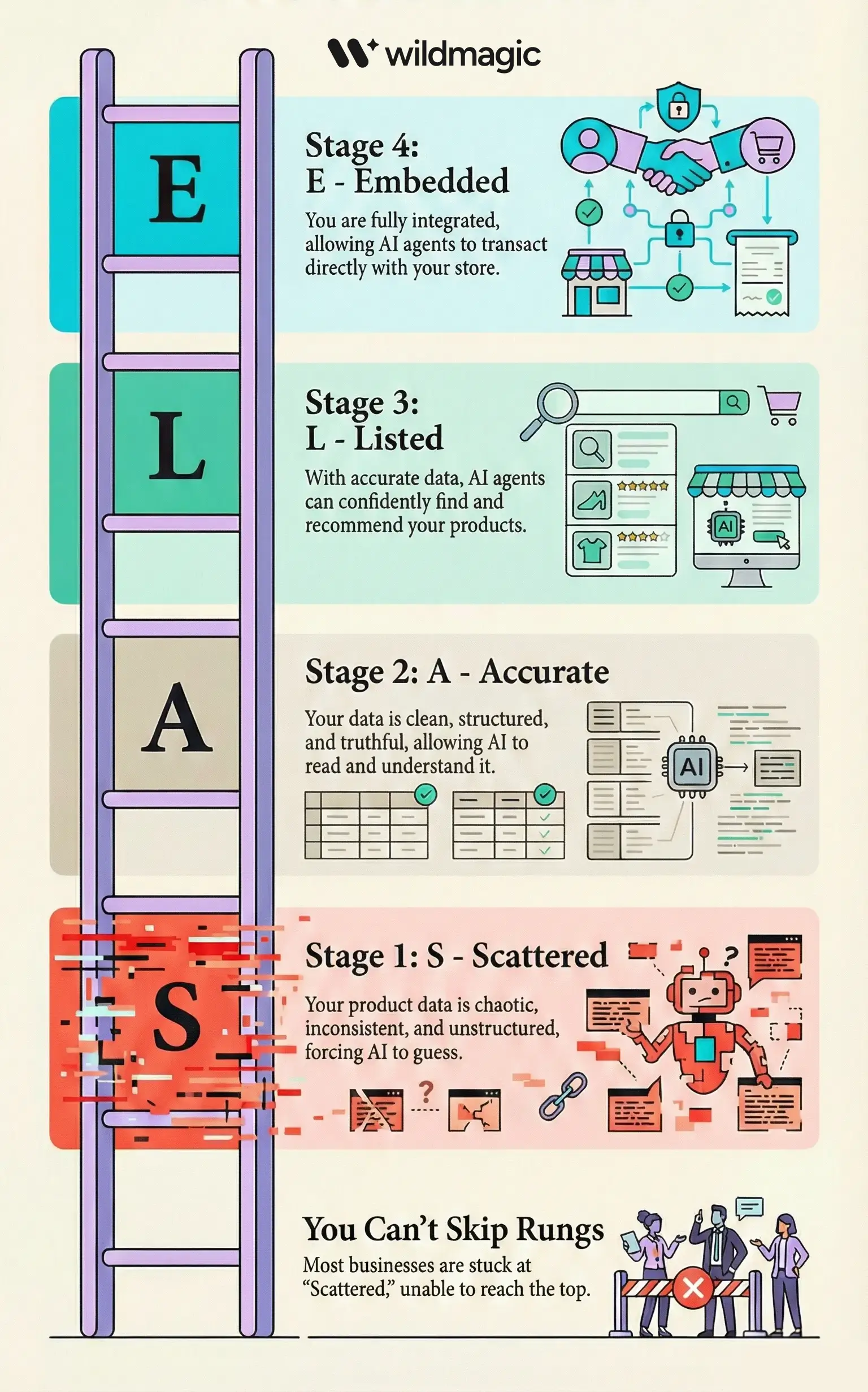
And here's the thing: you can't skip rungs.
Can't be Embedded if you're not Listed yet. Can't be Listed if you're not Accurate. Can't be Accurate if your store is still Scattered.
UCP? That's rung E. The top. Google just opened the door to Embedded commerce.
But most stores are still at S. Fighting bots that existed before ChatGPT was even a concept.
Stage S — Scattered (Where Most Stores Are)
The information usually exists somewhere in your store. Buried in product descriptions. Scattered across specs tables. Mentioned in reviews. Implied by category placement.
But scattered information might as well not exist for AI. It needs structure.
Think about your own product knowledge. You know which products work together. You know which customers should buy what. You know the use cases. You know the limitations.
That knowledge is in your head. Maybe in your team's heads. It's not in your data layer where AI can access it.
Last week we audited a six-figure store. Their most popular product page literally says "If you came here from Google search, go check this other product instead." For Google to read. That store wants AI agents to handle checkout for them?
Business impact at Stage S: You're invisible to AI. Or worse, AI confidently recommends wrong information about you.
Stage A — Accurate (The Foundation)
Getting AI-readable means externalizing that knowledge. Taking what you know about your products and expressing it as structured attributes AI can query.
What you build:
1. Technical Foundation
Before AI can understand your products, it needs to access your data correctly.
- Schema markup that matches your visible content. If your page shows $129 and your schema says $149, AI doesn't know which to trust.
- Structured data for product attributes. Not just title and price. SKU, availability, condition, shipping details, return policy. All machine-readable.
- Clean crawl paths. AI bots need to reach your product pages efficiently. If your site structure buries products five clicks deep or blocks them with JavaScript, AI can't index them properly.
- Consistent data across all touchpoints. Your product feed, your on-site data, your schema markup, all saying the same thing. Contradictions create hallucinations.
We covered this in depth in our llms.txt reality check for e-commerce, but the core principle applies here: AI needs clean, structured pathways to your product data. The format matters less than the underlying data quality.
2. Attribute Clarity
AI needs to know what your products are for. Not just what they are.
- Explicit use case data. "Running shoes" isn't enough. "Running shoes for marathon training on paved surfaces" teaches AI when to recommend this product.
- Compatibility relationships made clear. This camera body works with these lenses. This case fits these phone models. Explicit connections, not assumptions.
- Constraint data surfaced. What this product can't do. Who it's not for. Where it doesn't work. Negative space helps AI eliminate bad recommendations.
- Specifications in standardized formats. Not "battery lasts all day." "Battery: 30 hours typical use, 20 hours heavy use." Specific. Measurable. Comparable.
Business impact at Stage A: AI reads the truth about your products. No more guessing. No more hallucinations.
Stage L — Listed (AI Recommends You)
This is where you start showing up in AI answers. Gemini, ChatGPT, Perplexity surface your products when relevant queries appear.
What you build:
1. Content Optimization
Your product descriptions need to work for both audiences. Humans and machines.
- Humans want story. Lifestyle context. Emotional connection. AI wants facts. Attributes. Use cases. Both need to exist in the same content.
- The description can't just be marketing copy. "Revolutionary design meets cutting-edge technology" tells AI nothing. "Wireless noise-canceling headphones with 30-hour battery, suitable for office work and travel, not recommended for intense workouts due to fit" tells AI exactly when to recommend this product.
- Category pages need semantic structure. Not just products grouped arbitrarily. "Running Shoes" with subcategories that make sense conversationally. "Trail Running," "Road Running," "Track Running." Not "Men's Running Shoes" and "Women's Running Shoes." Gender is an attribute. Use case is a category.
- Product relationships explicitly defined. Frequently bought together. Compatible accessories. Required add-ons. AI needs these connections spelled out.
2. Direct Offers
Now connect this to Direct Offers.
You create an offer: "20% off running shoes, free shipping over $100."
Someone asks Gemini: "I need running shoes for marathon training under $150."
AI checks your Direct Offer. Sees 20% off brings some shoes under $150. Surfaces your offer.
But if you're not at Stage A first? User clicks through. Your product page loads. The shoes AI recommended are actually trail running shoes. Or they're out of stock in common sizes. Or they're not suitable for marathon training.
Direct Offers amplify your data quality. Good data becomes good recommendations. Bad data becomes confident misinformation.
Business impact at Stage L: You show up in AI answers. AI recommends your products when relevant queries appear.
Stage E — Embedded (AI Transacts For You)
This is UCP. This is why Google announced everything at NRF.
What you build:
- UCP endpoint integration
- Business Agent configuration
- Real-time inventory/pricing APIs
- Transaction layer readiness
Business impact at Stage E: AI doesn't just recommend you, it closes the sale. Checkout happens inside Gemini. You're part of the protocol.
You can't skip rungs. The protocol is live. But the ladder hasn't changed. It just got taller. Most stores haven't even started climbing yet.
The Maintenance Reality
Here's the part most stores don't think about until after they've implemented everything.
Your catalog changes. New products launch. Prices shift. Inventory fluctuates. Seasonal campaigns rotate. AI doesn't automatically know about these changes. Your data needs to stay current.
A Direct Offer pointing to outdated pricing isn't just ineffective. It's actively harmful. AI recommends your product. User clicks through. Price is wrong. Trust breaks.
This isn't a one-time optimization project. It's ongoing data maintenance. How often you need to update depends on your catalog volatility and business model. We broke down the actual update frequencies needed in our 2026 AI freshness playbook, but the core principle is simple: stale data creates confident misinformation.
This is why AI readability comes first. Not as a nice-to-have. As the foundation everything else depends on.
You can't optimize for conversational commerce if conversations about your products are based on wrong information.
The Window Is Narrowing
Google announced this at NRF in January 2026. Direct Offers is live in Merchant Center. AI Mode checkout is operational. UCP documentation is public. Not beta. Not coming soon. Live.
Google doesn't ship complete infrastructure for experiments. They shipped everything at once. That tells you this isn't experimental. This is the direction.
What Happens in 30/60/90 Days
Next 30 Days: Audit your current state. Ask ChatGPT, Gemini, Perplexity about your products. Are prices right? Recommendations appropriate? Check your technical foundation. Schema accuracy, feed consistency, inventory freshness. Identify your highest-value products. Start there.
Next 60 Days: Implement structured attributes for priority products. Set up first Direct Offers. Small tests. Learn what works. Establish update processes before you need them.
Next 90 Days: Expand to full catalog. Connect commerce data to UCP endpoints. Measure what's changing. AI-referred traffic, conversion rates, which offers work. Build baseline data.
The Competitive Advantage
Six months of early testing gets you:
- Knowledge of which attributes AI actually uses for matching
- Understanding of which offer structures AI surfaces most
- Clean product data that benefits everything, not just AI
- Operational processes for keeping data current
Your competitor six months from now is just learning Direct Offers exist. You already have data showing what works. That gap doesn't close quickly.
The Real Cost of Waiting
Your data doesn't improve while you wait. The inconsistencies confusing AI today will still confuse AI six months from now. Waiting doesn't make implementation easier. It delays the work.
Early movers are learning while you're debating. They're testing while you're waiting. By the time you decide to act, they'll have months of optimization. You'll be starting from zero against refined systems.
This isn't voice search, where waiting didn't hurt. Conversational commerce is being pushed by every major AI platform simultaneously. Google, OpenAI, Anthropic, Perplexity. Four platforms building it simultaneously is a clear signal.
One More Thing
Figure out your current state. Open ChatGPT. Ask about your product category. See who gets mentioned. See if information is accurate.
Not showing up? Data visibility problem. Showing up with wrong information? Data quality problem. Both need fixing before Direct Offers help.
If your data is clean and AI understands your products, implement Direct Offers now. Learn what works while the field is empty.
If your data needs work, fix the foundation first. Schema accuracy. Attribute clarity. Content structure. The layer everything else depends on.
We've been testing AI optimization since early 2025. We know which attributes AI actually uses. Which formats work reliably. Which maintenance cadences keep stores accurate.
Book a call. I'll show you what AI currently says about your store. What's accurate, what's wrong, what's missing. No pitch. Just current state and what fixing it looks like.
The window for early advantage is open. Not for long.
— Emre