

The 2026 E-commerce Guide to Getting Cited by ChatGPT
A practical playbook for e-commerce store owners to optimize their products for ChatGPT citations. Exact numbers, specific fixes, no fluff.
Product information is one of the most asked query types in ChatGPT in 2025. In fact, 21.3% of all queries are directly related to either product information or collecting information. If you add how-to guides, the figure jumps to almost 35%. One in every three queries in ChatGPT is about either collecting information about things or buying them. (Here's the source.)
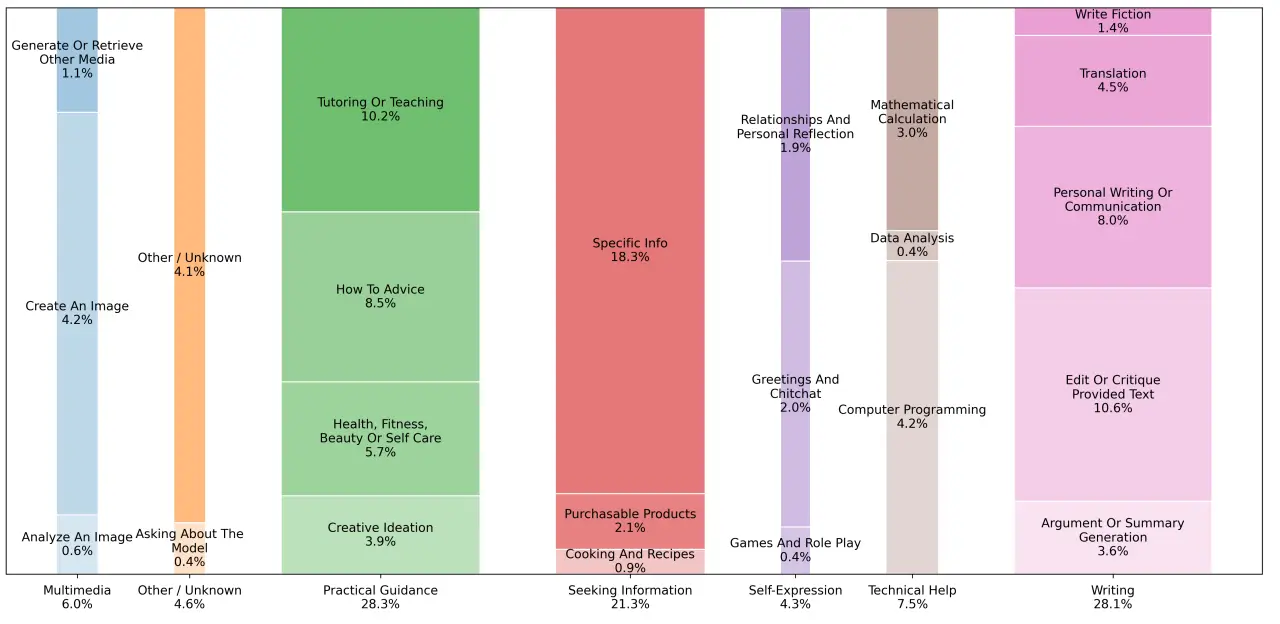
Here's what most store owners get wrong: they assume ChatGPT works like Google. They think ChatGPT provides 10 blue links to users. And if they optimize their store once, it will be all okay.
But ChatGPT does more than just crawl and serve links.
I oversimplify, but at the very core, Google wants you to optimize and build a trustworthy website. It looks at your domain authority, backlinks, on-page optimizations, even what others say about you. Then it decides whether you should be visible for certain queries or not.
ChatGPT, on the other hand, works differently. First and foremost, it doesn't pull anything from Google's index. ChatGPT works with Bing. (We'll get back to this later.) ChatGPT checks what others say about your products: your Amazon reviews, your forum mentions, random Reddit comments praising your products. And most importantly, it crawls your product information in a specific way that it thinks is the most efficient method to get the latest, most correct information. If you don't optimize your store for ChatGPT and you're invisible outside of your own store page, there's no reason ChatGPT recommends you over a competitor who does all these things. Even if your products are superior to theirs.
This guide is the specific playbook for fixing that. Not theory. Not "AI is changing everything." Just what to do, with exact numbers, so you can check your own store and know where you stand.
How ChatGPT Actually Finds Products
Let's start with something that surprises most store owners: ChatGPT doesn't use Google. At all. When ChatGPT searches the web, it uses Bing as its starting point. If your store ranks well on Google but doesn't exist on Bing, ChatGPT might never find you in the first place.
(We have a separate guide on Bing optimization. For now, just know: Bing visibility is a prerequisite, not a bonus.)
Here's what happens when someone asks ChatGPT for product recommendations. ChatGPT doesn't just pull your product page and read it like a human would. It uses something called RAG (Retrieval-Augmented Generation). I'll spare you the technical details. What matters is this: ChatGPT combines keyword matching with semantic understanding to find relevant content. Studies show this hybrid approach improves retrieval accuracy by 48% compared to using either method alone.
But here's the part most people miss.
47.9% of ChatGPT's citations come from Wikipedia. Almost half. Why? Because Wikipedia has something your product page probably doesn't: external corroboration. Wikipedia articles are verified by multiple sources. The information is consistent. Other websites link to it and confirm it.
ChatGPT notices this pattern. It weights external third-party validation heavily. Your claims about your products matter less than what others say about your products. Amazon reviews. Forum discussions. YouTube videos mentioning your brand. Blog posts comparing you to competitors. Each of these creates a "corroboration point" that tells ChatGPT your product actually exists, actually works, and is actually worth recommending.
If your product only exists on your website, ChatGPT has to take your word for it. And ChatGPT doesn't like taking anyone's word for anything.
This is the fundamental shift. Google rewards authority you build on your own site. ChatGPT rewards proof that exists outside of it.
Where Most Product Pages Fail
Before we fix anything, let's figure out where you actually stand. These are the eight failures I see most often. Check your store against each one.
1. Thin Descriptions
If your product descriptions are under 500 words, ChatGPT has almost nothing to work with. Most stores copy manufacturer descriptions and call it a day. The problem? So does every other store selling the same product. ChatGPT sees identical text across twenty websites and has no reason to pick yours.
Quick check: Open your top 5 product pages. Count the words. If you're under 500, you have a problem. If you're under 300, you're invisible.
2. Answer Buried
ChatGPT extracts information from the top of your content. If your product description starts with company history or vague marketing language, and the actual product details come in paragraph four, ChatGPT might never see them.
Quick check: Read the first two sentences of your product description. Do they answer "what is this product and who is it for?" If not, your answer is buried.
3. Critical Information Trapped in Images
This one is everywhere. Your product page looks beautiful. Specs in a nicely designed graphic. Compatibility chart as an infographic. Feature callouts baked into lifestyle photos. The problem? ChatGPT can't read any of it. AI crawlers see images as blank boxes. If your friction coefficient, vehicle compatibility, or material composition only exists inside a PNG, that information is invisible.
Quick check: Disable images in your browser (or use a text-only browser mode) and look at your product page. Is the critical product information still there? If turning off images makes your product page useless, ChatGPT sees a useless page too.
4. No External Corroboration
This is the big one. If your product only exists on your website, ChatGPT has no external validation. It looks for Amazon reviews, forum mentions, YouTube videos, blog posts. If it finds nothing, it assumes your product either doesn't exist or isn't worth mentioning.
Quick check: Google your product name + "review". What comes up? If it's only your own website, you have a corroboration problem.
5. Low Review Volume
100+ reviews signals authority to ChatGPT. Below that threshold, you're not trusted enough to recommend confidently. This isn't just reviews on your site. ChatGPT counts Amazon, Trustpilot, Google Reviews, everything.
Quick check: Add up your reviews across all platforms. Under 100? That's your bottleneck.
6. Inconsistent Product Data
Your website says the brake pads are ceramic. Your Amazon listing says semi-metallic. Your eBay listing doesn't mention material at all. ChatGPT notices these contradictions and trusts you less because of them.
Quick check: Pick one product. Compare title, specs, and price across your website, Amazon, and Google Shopping. Any differences in facts (not just wording)?
7. Missing or Broken Schema
Schema markup is code that tells ChatGPT exactly what your page contains: product name, price, availability, ratings. Without it, ChatGPT has to guess. With broken schema, ChatGPT gets confused and might skip you entirely.
Quick check: Run your product page through Google's Rich Results Test. Any errors or warnings? That's broken schema.
8. Walls of Text
Long paragraphs (100+ words) are hard for AI to parse. ChatGPT works better with short, structured chunks. If your product description is three massive paragraphs with no headings, you're making extraction difficult.
Quick check: Look at your product descriptions. Can you see clear paragraph breaks and headings? Or is it a wall?
Score yourself:
- 0-2 failures: Minor tune-up needed
- 3-4 failures: Significant work ahead
- 5+ failures: Your products are likely invisible to ChatGPT
What Your Product Pages Actually Need
Now let's fix things. These are the on-page changes that make your products readable to ChatGPT.
Answer First, Always
Your first two sentences should answer the question: "What is this product and who is it for?" Not your company story. Not vague marketing. The actual answer.
Bad: "At Performance Parts Plus, we've been committed to quality since 1987. Our brake pads represent years of engineering excellence."
Good: "These ceramic brake pads are engineered for Ford Mustang GT owners (2015-2020) who need reliable stopping power for both daily driving and track days. They fit vehicles with factory Brembo brakes and 5.0L engines."
The good version is citable. ChatGPT can extract it and use it directly in a response. The bad version tells ChatGPT nothing useful.
Paragraph Length: 40-60 Words
This is specific and it matters. Paragraphs longer than 100 words are hard for AI to chunk and extract. Paragraphs under 40 words often lack enough context to be useful on their own.
The sweet spot is 40-60 words per paragraph. Each paragraph should contain one complete idea that makes sense even if someone reads it in isolation.
Description Depth: 400 - 1,000+ Words
Thin descriptions get ignored. For your important products, aim for 400 - 1,000 words. Not fluff. Actual substance.
Here's what a complete product description covers:
- Opening (answer-first paragraph)
- What this product is
- Technical specifications
- Vehicle or use compatibility
- Performance context (how it performs in real use)
- Comparison to alternatives (AI loves these)
- Expert perspective
- Installation or usage notes
- Customer feedback summary
You don't need all nine sections for every product. But your top sellers? Your highest-margin items? They need this depth.
Include Statistics and Specific Data
Pages with concrete statistics see 22% higher visibility in AI citations. Pages with quotes from experts or cited research see 30-40% higher visibility.
Don't write: "These brake pads perform well under high temperatures."
Write: "These brake pads maintain consistent friction (0.55-0.65 coefficient) at temperatures up to 1,200°F. In track testing, users report zero fade across 20+ consecutive high-speed stops."
The second version gives ChatGPT something concrete to cite. The first version is just a claim.
Schema Markup: The Technical Foundation
Schema markup tells ChatGPT exactly what your page contains without guessing. At minimum, every product page needs:
- Product schema (name, description, image)
- Offer schema (price, currency, availability)
- AggregateRating schema (rating value, review count)
If you have common questions about your products, add FAQ schema. Pages with FAQ schema achieve a 41% citation rate compared to 24% baseline. That's almost double.
Validate your schema using Google's Rich Results Test. If you see errors, fix them. If you see warnings about missing fields, add them.
Bing Visibility: The Prerequisite
Remember: ChatGPT uses Bing, not Google. If Bing can't find you, ChatGPT won't either.
Quick wins:
- Set up Bing Webmaster Tools
- Submit your sitemap
- Check that your products are actually indexed
This isn't optional. It's the foundation everything else builds on.
The Corroboration Game (What Happens Outside Your Store)
Here's where most store owners stop. They fix their product pages, add schema, write better descriptions. Then they wait. Nothing happens.
On-page optimization is necessary but not sufficient. ChatGPT needs to see others talking about your products. This is the corroboration game, and most stores aren't playing it.
Review Volume: The Trust Threshold
ChatGPT uses review volume as a confidence signal. Here's how it breaks down:
- Under 100 reviews: Not enough data to recommend confidently
- 100+ reviews: Authority threshold. ChatGPT starts trusting you.
- 150+ reviews: Target range. You're in the consideration set.
- 200+ reviews: High visibility. You're a default recommendation.
This isn't just reviews on your website. ChatGPT counts everything: Amazon, Trustpilot, Google Reviews, eBay ratings. Add them up across all platforms.
Freshness matters too. A product with 200 reviews from 2022 looks abandoned. Aim for 2+ new reviews per month to signal that people are still buying.
Third-Party Mentions: Proof You Exist
Every mention of your product outside your website creates a corroboration point. ChatGPT finds these and uses them to validate that your product is real, works, and is worth recommending.
Where to build mentions:
- Blogs and publications in your niche
- YouTube reviews (even small channels count)
- Reddit discussions (authentic participation, not spam)
- Forum threads in enthusiast communities
- Comparison articles that include your products
For automotive parts, this means getting mentioned in Mustang forums, reviewed by car YouTubers, discussed in r/Mustang or r/cars. Each mention is a signal.
Retailer Presence: Corroboration Points
Listing your products on Amazon isn't just another sales channel. It's a corroboration point. Same with eBay, Walmart Marketplace, or any other retailer.
When ChatGPT sees your brake pads on your website AND on Amazon AND mentioned in a forum thread AND reviewed on YouTube, it thinks: "This product clearly exists and people clearly buy it." When ChatGPT only sees your website, it thinks: "Maybe. Maybe not."
The "As Seen In" Page
Here's a tactic most stores miss. Create a dedicated page on your website that links OUT to all your external mentions.
Structure it like this:
- Press features (with links to articles)
- Third-party reviews (Amazon, Trustpilot, YouTube)
- Expert reviews and comparisons
- Awards and recognition
- Media mentions
Why does this work? ChatGPT crawls your site and follows these outbound links. It sees that your brand is mentioned and endorsed by other sources. You're essentially handing ChatGPT a list of your corroboration points.
Brand Consistency Across Channels
ChatGPT recognizes your brand as an entity across the web. If your brand name is slightly different on Amazon versus your website versus your social profiles, you're fragmenting your authority.
Quick checklist:
- Brand name: exactly the same everywhere
- Product identifiers (GTIN/SKU): matching across all channels
- Pricing: consistent (within 10% for promotions)
- Product descriptions: facts should match, even if wording differs
Inconsistency creates confusion. ChatGPT doesn't know if "Performance Parts Plus" and "PerformanceParts+" and "PP Plus Auto" are the same company. Keep it identical.
The Consistency Rule
I mentioned consistency in the last section, but it deserves its own emphasis. This is where stores sabotage themselves without realizing it.
ChatGPT doesn't just see your products. It sees your brand as an entity that exists across the entire web. When it finds your brand mentioned in multiple places with consistent information, it builds confidence. When it finds contradictions, it loses trust in everything you say.
Think about it from ChatGPT's perspective. It finds "AutoParts Pro" on your website, "Auto Parts Pro LLC" on Amazon, "AutoPartsPro" on eBay, and "AP Pro" on your Facebook page. Is this one company or four? ChatGPT doesn't know. So it hedges. It might recommend a competitor whose brand identity is crystal clear instead.
The Full Consistency Checklist:
- Brand name: exactly the same everywhere, character for character
- Logo: same design and colors across all platforms
- Brand tagline: identical messaging
- Company description: same core message (wording can vary, facts cannot)
- Contact information: consistent phone, email, address
- Social profiles: linked and verified
- Product identifiers: same GTIN/MPN/SKU across all channels
Quick diagnostic: Pick one product. Check your website, Amazon, eBay, and Google Shopping. Is the brand name identical? Are the product specs identical? Is the price within 10%?
If you find discrepancies, fix them before doing anything else. Inconsistency undermines every other optimization you make.
Quick Reference Checklist
Everything above, condensed. Bookmark this.
On-Page
- Descriptions are 400-1,000+ words for important products
- First 2 sentences answer "what is this and who is it for"
- Paragraphs are 40-60 words
- Critical information is in text, not trapped in images
- Statistics and specific data included (not just claims)
- Product schema implemented (name, description, image)
- Offer schema implemented (price, currency, availability)
- AggregateRating schema implemented (rating, review count)
- FAQ schema on pages with common questions
Off-Page
- 150+ reviews across all platforms combined
- 2+ new reviews per month (freshness signal)
- Product listed on Amazon or other major retailers
- 3+ third-party mentions (blogs, YouTube, forums)
- "As Seen In" page created with outbound links to mentions
- Press coverage or awards documented and linked
Consistency
- Brand name identical across all channels
- Product identifiers (GTIN/SKU) match everywhere
- Pricing consistent across platforms (within 10%)
- Product specs don't contradict between channels
Technical
- Bing Webmaster Tools set up
- Sitemap submitted to Bing
- Schema validates in Google Rich Results Test (no errors)
- Products actually indexed in Bing (check URL inspection)
One More Thing
If you've read this far, you're serious about this. Good. Most store owners won't do any of it.
I don't know your store yet. I don't know if you need a minor tune-up or a complete overhaul. But I do know this: a 30-minute call will tell us both. Book a free audit and I'll show you what ChatGPT actually says about your products right now. No pitch, no pressure. If it makes sense to work together, we'll talk about that. If not, you'll still walk away knowing something you didn't before.
— Emre